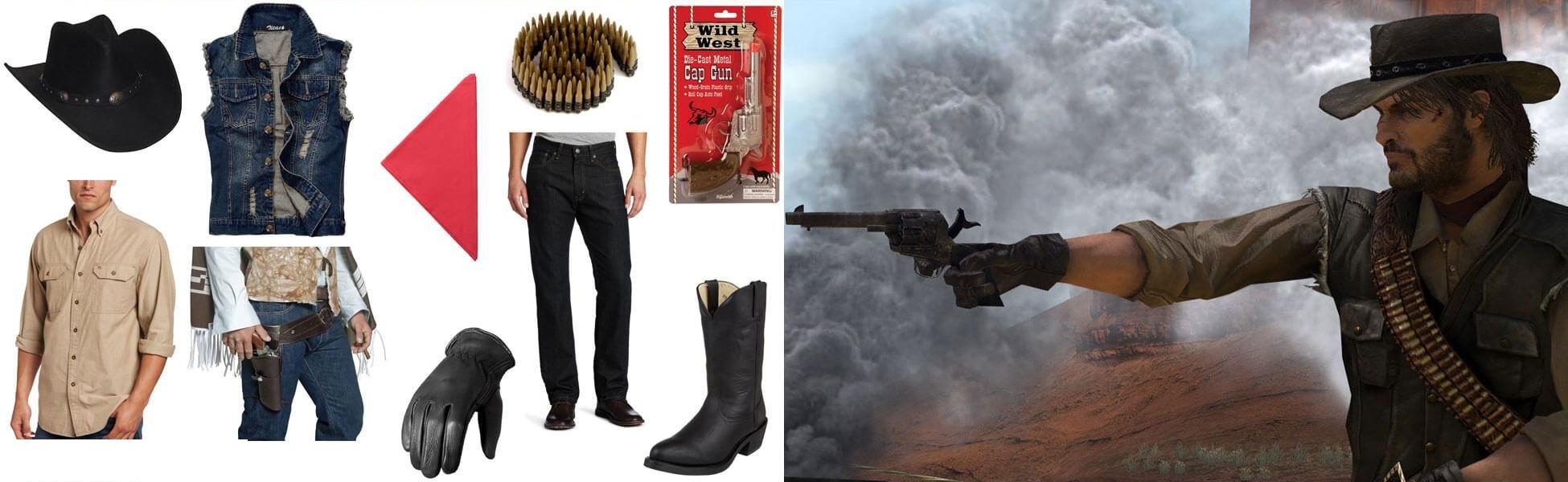
John Marston’s classic look from Red Dead Redemption is grounded in functional, weathered frontier workwear. Between the open denim vest, faded work shirt, and heavy leather rigging, the outfit feels practical rather than theatrical. Because the core pieces stem from traditional Western clothing, assembling the base layers is straightforward, leaving you to focus on the silhouette, the wear patterns, and the distinct hardware that set Marston apart from a generic rancher.
The overall impression depends heavily on texture. Off-the-shelf garments can look too clean and uniform for an outlaw roaming 1911 New Austin. Getting the contrast right between the light tan shirt and the dark denim vest gives you the correct foundation, after which proper placement of the gun rig and bandolier establishes the rugged profile.
The Shirt, Denim Vest, and Neckerchief
Marston’s upper body relies on three distinct layers. Start with a tan western shirt made from sturdy cotton or twill, featuring a standard spread collar and long sleeves. You can roll the sleeves up past the wrists or wear them buttoned, but leaving the collar unbuttoned at the neck is necessary to accommodate the bandana. A simple red neckerchief folds into a neat triangle and ties snugly at the throat, with the tails resting against the chest under the shirt placket.
Over the shirt sits a dark denim vest. Marston wears a cut that resembles a sleeveless trucker jacket, stopping right at the waistline so it doesn’t obstruct the gun belt. A dark or medium-wash denim vest provides the proper visual separation against the lighter tan fabric. If the denim looks brand new, distressing the seams with sandpaper or brushing diluted brown acrylic wash into the collar and armholes helps knock down the factory finish.
Leather Harness and Weapon Rig
The leather harness setup gives Marston his unmistakable outlaw silhouette. A brown belt and holster forms the lower anchor, designed to ride slightly tilted on the right hip for a quick-draw cant. The holster holds a traditional revolver prop, such as a wild west metal cap gun with a realistic weight and finish. Adjust the belt so it sits firmly on the pelvic bone rather than high around the natural waist.
A bandolier bullet belt loops across the torso, running from the left shoulder diagonally down to the right waist. Because heavy bandoliers tend to slide off the shoulder during movement, tacking a hidden safety pin through the vest seam keeps the strap locked in place throughout a convention day. Add a pair of unlined black leather gloves to finish the hands and protect your palms when handling props.
Pants and Footwear
For the lower half, a pair of black jeans in fume offers the right muted, charcoal-adjacent tone. Pure jet-black pants can look jarring against earth-toned leather, whereas a faded wash blends seamlessly into the dusty aesthetic. Select a straight-leg cut with enough room at the hem to fall cleanly over the tops of your boots without bunching excessively or flaring out.
Western boots in oiled black anchor the legs with a classic roper or cowboy boot silhouette. An oiled leather finish handles scuffs well and naturally gathers dust along the welt. While Marston occasionally sports metal spurs over his heels, the plain black boots alone provide the proper height and rugged stance.
The Hat and Facial Scars
No John Marston costume functions without his signature headwear. A black leather outback hat features a wide, moderately curved brim and a creased crown that casts a deep shadow over the eyes. Adding a slim braided band or weathered cord around the base of the crown replicates the battered, sun-baked character seen in the game.
Beneath the brim, Marston’s face tells his story. His look requires shoulder-length dark brown hair, an unkempt beard with heavy stubble, and his prominent facial scars. Two parallel scars slash diagonally across his right cheek, while a third crosses the bridge of his nose. You can sketch these scars using a dull pinkish-brown lip pencil and then paint a layer of rigid collodion directly over the lines. As the collodion dries, it naturally puckers the skin to create convincing indented scar tissue without complex prosthetics.